How Hot is Too Hot?
Summer in Westchester is beautiful – the parks are lush, the trails are calling, and your dog is practically vibrating with excitement every time you reach for the leash. But as much as we all love this season, the heat can turn dangerous for our pups faster than most of us realize.
At Just Happy Dogs, we think about this a lot, especially during July and August when the humidity in the Hudson Valley sits heavy and thick. Over the years of caring for dogs, we’ve seen how quickly a warm afternoon can become overwhelming for a dog – even a young, healthy one. So let’s talk about the numbers, the warning signs, and what you can do to keep your dog safe when the thermometer climbs.
Why Dogs Overheat Faster Than You Think
Dogs cool themselves almost entirely through panting. Unlike humans, who sweat across the whole body, dogs release heat through their mouths and paw pads. It’s a much less efficient system – which means they can go from comfortable to dangerously overheated in a surprisingly short window of time.
- Brachycephalic breeds (Bulldogs, Pugs, French Bulldogs, Boxers) have shortened airways that make panting even less effective. They overheat faster and are at higher risk of heat stroke.
- Dark-coated dogs absorb more radiant heat from the sun.
- Overweight dogs and senior dogs struggle more because their cardiovascular systems have to work harder just to maintain normal body temp.
- Health conditions and medications can significantly affect a dog’s heat tolerance. Heart disease, respiratory issues, thyroid problems, and certain medications (including antihistamines, diuretics, and some sedatives) can impair a dog’s ability to regulate body temperature. If your dog is on any medication or managing a health condition, check with your vet about heat precautions – their safe threshold may be lower than a healthy dog’s.
- High humidity is the hidden danger. When the air is already saturated with moisture, panting becomes even less effective because evaporation slows down. Your dog can overheat even when the actual temperature seems moderate.
And here’s the thing: even a perfectly healthy dog is not immune. Heat exhaustion doesn’t discriminate. Given the wrong combination of temperature, humidity, and exertion, any dog can overheat. Don’t assume your fit, energetic dog is safe just because they seem fine – watch for the signs every time you’re out in the heat.
The Temperature & Humidity Chart
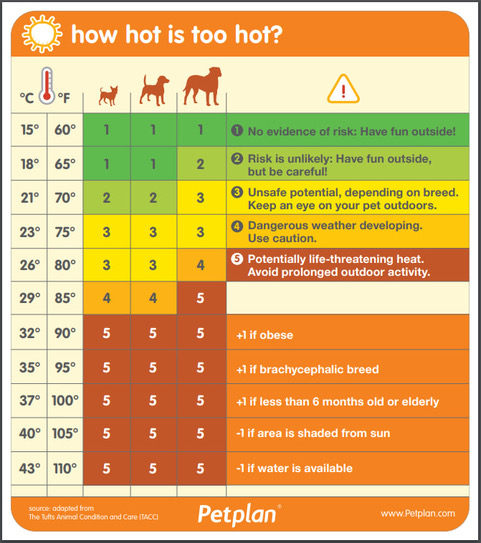
The chart to the right (sourced from Petplan) is one of the most useful tools we’ve found for making quick heat-safety decisions. It maps the combination of temperature and humidity to risk level – safe, use caution, dangerous, and extreme danger.
- At 75°F with 90% humidity, conditions are already in the caution zone for many dogs.
- At 80°F with 80% humidity – a pretty common summer afternoon in Peekskill – you’re in dangerous territory.
- Anything above 90°F should generally mean outdoor time is cut short, moved to early morning, or skipped altogether.
Bookmark this chart. Screenshot it. It’s one of the simplest ways to make an informed call before you head out.
Warning Signs of Heat Exhaustion in Dogs
Knowing what to watch for can make all the difference. Heat exhaustion can escalate to heat stroke quickly, and heat stroke can be fatal. If your dog shows any of these signs, take action immediately:
- Heavy, frantic panting that doesn’t slow down
- Excessive drooling – thick, ropy saliva
- Bright red gums or tongue
- Glassy, unfocused eyes
- Weakness or stumbling – wobbly on their feet
- Vomiting or diarrhea
- Collapse or loss of consciousness – this is an emergency
If you see the early signs (heavy panting, drooling, redness), move your dog to a cool area immediately and start cooling them down. If they progress to weakness, vomiting, or collapse, call your vet or an emergency animal hospital without delay. Heat stroke can cause organ damage within minutes.
How to Cool Your Dog Down Fast
Overheating is a medical emergency. Every minute your dog spends at a dangerously elevated temperature increases the risk of organ damage, neurological harm, and death. Do not wait to see if they “snap out of it.” Act immediately – then get to a vet.
- Get them out of the heat immediately. Into air conditioning, shade, or anywhere cooler than where they are. Stop all movement and exercise right away.
- Pour cool water over their body. According to current veterinary guidelines, cool water is effective and appropriate – you do not need to wait to find “perfectly lukewarm” water. Focus on the neck, belly, armpits, and inner thighs, which have more exposed blood vessels. Avoid pouring water over the head and face, especially for flat-faced breeds, as it can make breathing harder.
- Do not place wet towels over the dog. This is a common instinct, but draping a towel over a dog’s body can actually trap heat and slow cooling. If you want to use a wet towel, place it underneath the dog rather than on top.
- Add airflow. Fan the dog or position them near a fan while they’re wet. The combination of cool water on the skin and moving air – known as evaporative cooling – is one of the most effective methods recommended by veterinary experts.
- Offer small sips of water. Let them drink at their own pace. Don’t force it.
- Avoid ice packs directly on the skin. Concentrated cold applied directly to the skin can cause blood vessels near the surface to constrict, which may slow the transfer of heat out of the body. Cool water and airflow are more effective.
- Get to a vet – even if they seem to recover. Internal damage from overheating isn’t always obvious right away. A dog that seems to bounce back still needs to be evaluated. Call ahead so your vet is ready when you arrive.
The mantra from veterinary professionals is simple: cool first, transport second. Start cooling before you’re even in the car.
The Pavement Burn Test
Here’s a simple rule that’s easy to forget: if you can’t hold the back of your hand to the pavement for 7 seconds, it’s too hot for your dog’s paws.
Asphalt and concrete absorb heat from the sun and can reach temperatures of 130–150°F on a hot summer day – even when the air temperature is only in the mid-80s. Dog paw pads can blister and burn in seconds on pavement that hot.
Before your walk, press the back of your hand firmly on the sidewalk or road surface. If it’s uncomfortable after 7 seconds, skip the walk, shorten the route to stay on grass, or wait until evening when surfaces have had time to cool.
And here’s something worth remembering: grass is almost always significantly cooler than pavement. Grassy surfaces absorb far less radiant heat from the sun than concrete or asphalt, which makes them a much safer surface for hot-day outings. Here at Just Happy Dogs, our shaded backyard gives dogs a place to go outside without the risk of burning paws – cool grass, shade, and fresh air, rather than hot concrete. When the heat index is high, that’s exactly where outdoor time happens.
Signs Your Dog May Have Burned Paw Pads
The tricky thing about paw pad burns is that dogs often don’t show obvious pain right away – the adrenaline of a walk can mask the discomfort until you’re back home. Watch for these signs after any outing on hot pavement:
- Limping or favoring one or more paws after a walk
- Licking or chewing at the paws excessively – this is often the first thing owners notice
- Pads that look darker than usual, discolored, or have a reddish tint
- Blisters, raw patches, or loose/peeling skin on the pads
- Pads that feel unusually soft or tender to the touch compared to normal
If you notice any of these, rinse the paws gently with cool water, keep your dog off hard surfaces, and call your vet. Burned pads can become infected quickly and may need treatment. Don’t wait and see – paw injuries are more painful than they look.
Never Leave a Dog in a Parked Car
This one deserves its own section because it’s still one of the most common – and preventable – causes of heat-related death in dogs every summer.
On an 85°F day, the inside of a parked car can reach 102°F within 10 minutes. Within 30 minutes, that temperature can climb to 120°F or more. Cracking a window makes almost no difference. Parking in the shade helps a little, but not enough. The greenhouse effect inside a vehicle happens fast and is relentless.
Dogs can suffer irreversible organ damage or die in less time than it takes to run a quick errand. There is no safe amount of time to leave a dog in a parked car on a warm day in summer – not five minutes, not “just while I grab coffee.”
If you see a dog alone in a hot car showing signs of distress, call 911. In New York State, law enforcement officers are authorized to break a vehicle window to rescue an animal in danger. Don’t walk past it.
The rule is simple: if you can’t take your dog with you where you’re going, leave them home.
How Just Happy Dogs Keeps Your Dog Safe This Summer
Here at Just Happy Dogs, summer safety isn’t an afterthought – it’s built into how we operate every single day.
Our home is climate-controlled, which means when it’s 85° and humid outside, the dogs in our care are inside in the air conditioning where they’re comfortable. We don’t have kennels, crates, or runs where dogs wait out the hot parts of the day. Everyone’s together, in a real home environment – and fresh water is always available, along with shade and cool spaces to rest.
When we do go outside – for potty breaks, play, or a short walk – we check the temperature and humidity before we head out and use the heat index to make the call each day. If conditions aren’t safe, outdoor time is adjusted. It’s that simple. And when dogs do go out, they’re in our shaded backyard with cool grass underfoot – not on hot pavement.
We also keep a close eye on each dog for signs of overheating throughout the day. That means watching for the signals that come before a dog is in crisis: gum color is one of the first things we check. Healthy gums should be pink and moist – pale, white, or bright red gums can signal that something’s wrong. We also watch for changes in energy level, breathing rate, the texture of their drool, and how quickly they settle after being outside. We don’t take rectal temperatures here, but you don’t need to reach for a thermometer to catch the early warning signs – you just have to know what you’re looking at and pay attention.
We’re also cage-free and kennel-free, which means dogs can move around, find a cool tile floor to stretch out on, or settle near a fan. They’re not confined to a space that traps heat. And because we accept a maximum of four dogs at a time, we know each dog in our care – their breed, their age, whether they tend to run hot, how they respond to heat. That kind of individual attention just isn’t possible in a large boarding facility.
We’re Fear Free Certified and a member of NAPPS, and keeping dogs safe – physically and emotionally – is at the center of everything we do here. Summer is a great season. It should feel that way for your dog, too.
Ready to Book a Safe, Cool Summer Stay?
Whether you’re heading out of town or just need a safe place for your dog on a hot workday, we’d love to help. Learn more about our services and reach out to check availability:
- 🐾?? Dog Boarding – overnight care in a real home, never a kennel
- ?? Doggy Daycare – a safe, fun, climate-controlled day while you’re at work
Serving Peekskill, Westchester County, and surrounding areas. Have questions? Get in touch – we’re always happy to chat.